
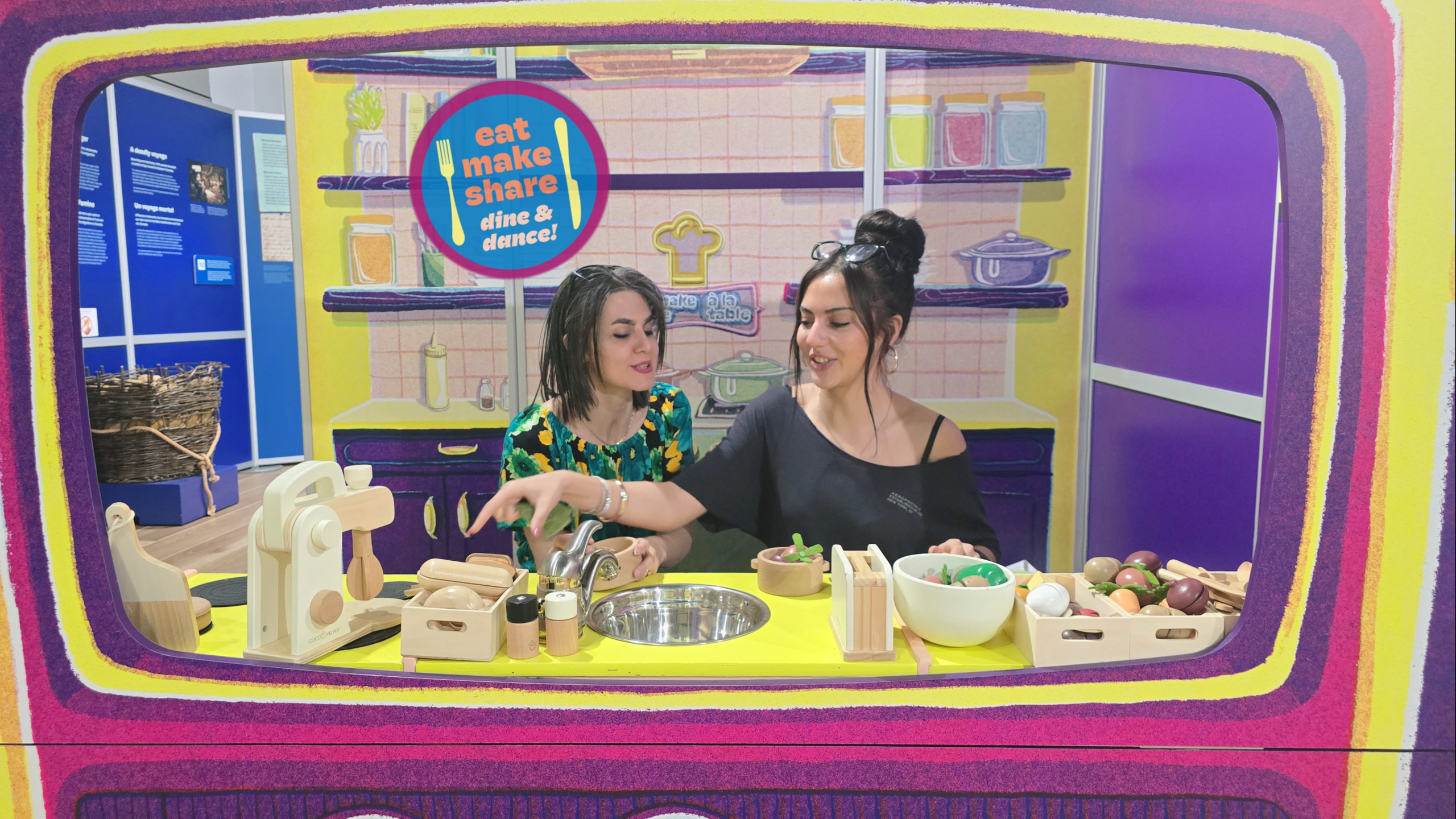
Then Told Me About the Grandmother They Left Behind in Iran.
Part of danceScape’s eat make share… dance! series in collaboration with the Museums of Burlington.
What started as a Persian dance challenge became a conversation about family, food, immigration, and the traditions that help us stay connected to home.
Recently, I had the pleasure of sitting down with Gina and her mother, Farnaz, at the Museums of Burlington’s eat make share: a taste of immigration exhibition.
The exhibition explores immigration stories through the lens of food. What surprised me was how naturally the conversation expanded beyond food and into something deeper.
Family.
Memory.
Belonging.
And ultimately, dance.
Growing Up at Grandma’s House
One of the stories that stayed with me most came from Gina.
When she was five or six years old, she spent much of her childhood at her grandmother’s home in Iran.
In fact, she joked that she was rarely at her own house.
Much of Farnaz’s extended family lived together in the same apartment complex. Grandparents, aunts, uncles, and cousins were all nearby. Family members moved freely between homes. Meals were shared. Children were looked after by grandparents and relatives.
Family wasn’t something you scheduled time for.
Family was simply everyday life.
Gina spoke warmly about her grandmother and the important role she played in her childhood.
Then came a life-changing decision.
Her parents chose to immigrate to Canada.
As a child, Gina wasn’t happy about it.
She missed her grandmother.
She missed her cousins.
She missed the family gatherings.
She missed home.
Looking back now, however, she understands the decision differently.
As an adult, she recognizes the opportunities her parents hoped to create for their family and feels grateful for the sacrifices they made.
It was a powerful reminder that many immigration stories are also stories of love.
Parents leave familiar places not because they want to leave, but because they hope to build new opportunities for their children.
Food Is Never Just Food
Throughout our conversation, Farnaz returned to a theme that resonated deeply.
Food is never just food.
In Iranian culture, hospitality is woven into daily life.
Cooking for guests is a way of expressing care.
Sharing a meal is a way of building relationships.
Gathering around a table is a way of preserving culture.
Farnaz spoke about the importance of respecting elders and the central role grandparents play in family life.
She also shared a beautiful perspective about bread.
Bread, she explained, is more than nourishment.
It reflects humanity’s relationship with the earth.
The process of growing, harvesting, preparing, and sharing food reminds us that we are connected—not only to one another, but to the environment that sustains us.
It was one of those simple observations that stays with you long after a conversation ends.
Searching for the Taste of Home
Like many immigrant families, Gina and Farnaz faced a challenge when they first arrived in Canada.
Finding familiar ingredients.
Years ago, their family would often drive to North York and Richmond Hill in search of foods that reminded them of home.
The effort was worth it.
Those ingredients represented more than recipes.
They represented memories.
Traditions.
Family gatherings.
A connection to a life they had left behind.
Today, they are grateful to find many of those ingredients much closer to home.
One of the places they mentioned was Samir’s in Burlington, an Afghan grocery store known for carrying products familiar to many families from the region.
In particular, they spoke fondly about the bread.
Fresh, traditional bread that reminds them of what they enjoyed growing up.
For many North Americans, bread arrives as individual slices of toast.
For Gina and Farnaz, bread is often something shared.
Placed in the centre of the table.
Torn apart together.
Part of a communal experience.
Once again, food became a story about connection.
Every Family Has That One Recipe
The conversation wasn’t all serious.
Some of the best moments involved family cooking stories.
Gina laughed while talking about her father, who is known in the family as an excellent cook.
According to Gina and Farnaz, one of his favourite dishes uses a very generous amount of oil.
Possibly more than any nutritionist would recommend.
But unquestionably delicious.
The story reminded me of my own father.
Growing up, my father had a signature dish.
Fried noodles.
With ketchup.
Lots of ketchup.
As a child raised with traditional Asian manners, I would always politely thank him for making dinner.
What I never admitted was that I secretly thought the ketchup noodles were absolutely terrible.
Only years later could I finally laugh with him about it.
The exchange sparked laughter around the table.
Because every family has that dish.
The recipe everyone remembers.
The story everyone tells.
The meal that somehow becomes part of family history.
From Food to Dance
As our conversation continued, it naturally moved from food to another powerful expression of culture.
Dance.
Gina shared how much music and dancing are part of everyday life whenever she visits Iran.
Family celebrations often include music, dancing, and gathering together.
Dance is not something separate from life.
It is part of life.
The topic felt especially fitting because Gina and I had previously filmed a short danceScape video together.
In that video, I introduced her to a simple Bachata rhythm walk.
To my surprise, that brief experience sparked her curiosity about Latin dancing.
She shared that she would love to learn more.
This time, however, the tables were turned.
At danceScape, we always have a dance challenge.
So I asked Gina and Farnaz to challenge me.
What followed was an impromptu Persian dance lesson.
Gina demonstrated some of the shoulder movements, shoulder rolls, and rhythmic foot taps often seen in Persian social dancing.
There was plenty of laughter.
Plenty of coaching.
And plenty of opportunities for me to discover that Persian dance looks easier than it actually is.
More importantly, it became a beautiful example of cultural exchange.
A Canadian learning Persian dance.
An Iranian Canadian becoming curious about Latin dance.
Both discovering that movement can connect people across cultures.
The Traditions We Carry Forward
By the end of our conversation, one thing became clear.
The journey from Iran to Canada was not simply about changing countries.
It was about carrying traditions forward.
Family values.
Recipes.
Stories.
Music.
Dance.
And memories.
Food may have started the conversation.
But family became its heart.
And dance became its ending.
Perhaps that’s what makes the Museums of Burlington’s eat make share: a taste of immigration exhibition so powerful.
Every recipe has a story.
Every family has a story.
And sometimes those stories end with a dance.
Join Us for Latin Night at the Museum
Inspired by stories like these, danceScape is proud to partner with the Museums of Burlington for Latin Night at the Museum.
Explore the exhibition.
Enjoy music, culture, and community.
Learn a few Latin dance steps.
And discover how food, stories, and dance have the power to bring people together.
Because every culture has something worth sharing.
And sometimes all it takes is one conversation—or one dance step—to discover it.
Learn more: https://www.dancescape.com/latin-night-museum