
The Tang Papers document the development of a diagnostic framework for analyzing coordination, timing, representational structure, and experiential interpretation across complex systems
This independent research program by Lit Meng (Robert) Tang began through the study of human–AI interaction and expanded to examine broader questions of alignment, coherence, and coordination across systems.
This work examines not just what systems produce,
but how they coordinate over time.
Core Entry Concepts
Three complementary models provide primary entry points into this research:
• Phase Drift
A condition in which output continues while coordination degrades.
• The Loom
A structural model describing how patterns form when accumulation is coordinated under constraint.
• Relational Coherence Theory (RCT)
An extension of the framework into observer-dependent systems, formalizing how meaning is interpreted, reorganized, and persists across time within the experiential layer.
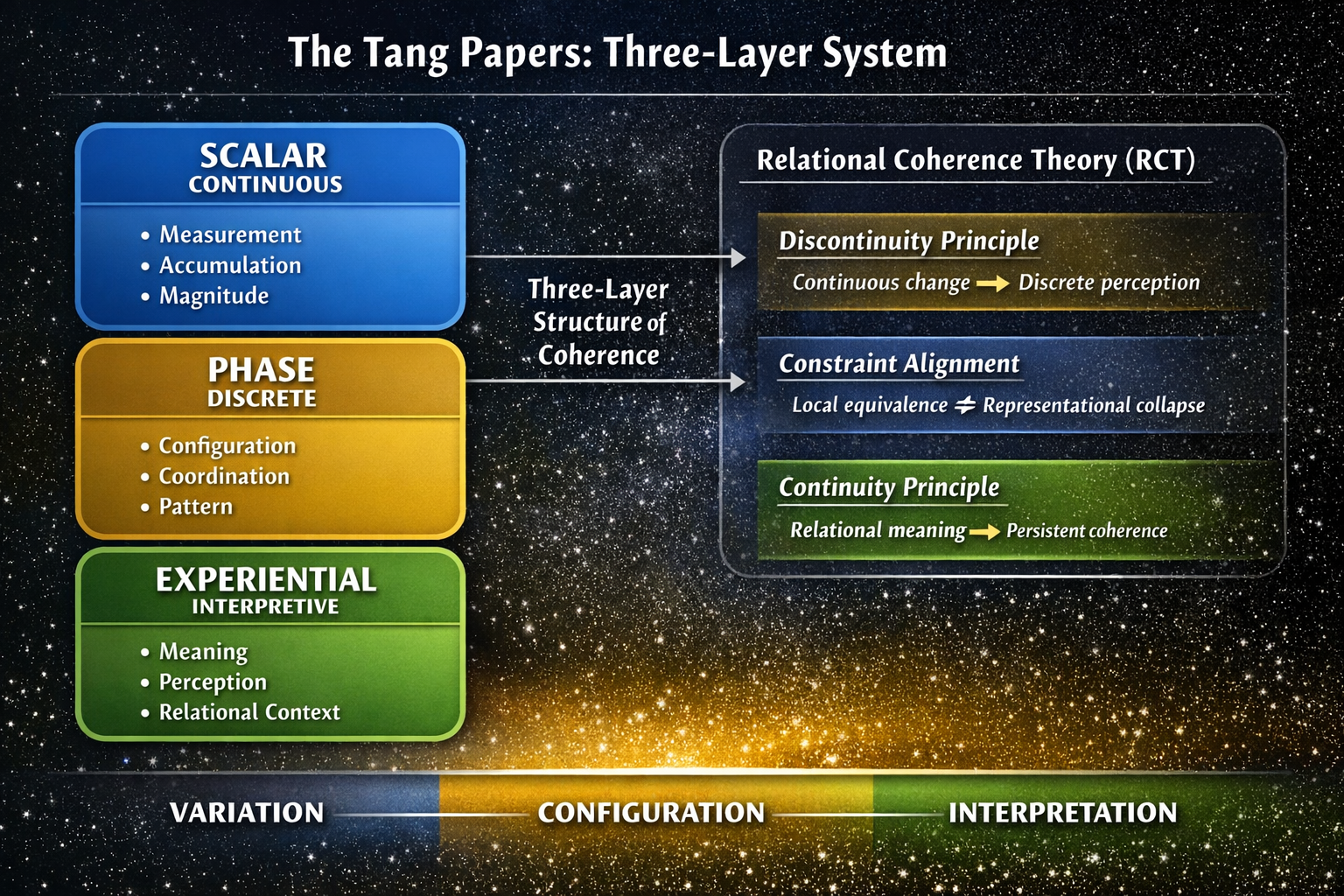
Together, these describe how systems form, degrade, and are interpreted across scalar, phase, and experiential layers.
Research Archive
All papers are published openly, citable, and archived with persistent identifiers (DOIs). View publications on Zenodo:
https://zenodo.org/communities/tang-papers-program
Latest Framework Extension — Relational Coherence Theory (RCT)
The most recent stage of the Tang Papers extends the Phase–Scalar framework into observer-dependent systems.
Relational Coherence Theory (RCT) formalizes the qualitative/experiential layer (QToE), which had previously been identified but not structurally defined.
It introduces:
- The Three-Layer Structure of Coherence (scalar, phase, experiential)
- The Discontinuity Principle (continuous change produces discrete perception)
- The Constraint Alignment Principle (local equivalence does not imply representational collapse)
- The Continuity Principle (relational meaning persists through experiential reconfiguration)
This extension demonstrates that the same structural distinctions used to analyze coordination and timing also apply to perception, meaning, and relational continuity.
👉 https://doi.org/10.5281/zenodo.19490531
Why This Matters
Across many domains, systems can appear coherent while remaining structurally misaligned.
- Artificial intelligence can generate convincing responses without full understanding.
- Organizations can communicate clearly while failing to coordinate.
- Social and political systems can maintain internal consistency while fragmenting across groups.
- Even in physics, different models can remain valid within limits while resisting reconciliation.
In some contexts, coordination dynamics can be directly observed as systems transition between dispersed and synchronized states.
The central question is not only what systems produce, but how their components are aligned and coordinated over time.
The Tang Papers examine these patterns and develop a framework for identifying where alignment holds—and where it breaks down.
In many systems, breakdown occurs not because output decreases, but because coordination fails under continued accumulation.
Hosting Context & Boundary Statement
This research archive is hosted on the danceScape platform for public access and public education.
danceScape is a dance education and wellness learning community whose primary focus is helping people experience the benefits of music and movement through:
- Ballroom dance
- Salsa & Latin dance
- Wedding Dance preparation
- danceTONE cardio fitness
- danceFLOW qigong / tai chi
- Community social events
danceScape is not a research institution.
Participation in danceScape classes, programs, or events does not constitute participation in research.
All research frameworks, publications, and claims presented here stand independently and are attributable solely to the author.
Start Here: The Tang Papers Program
This bridge paper provides the conceptual entry point into the full research corpus.
The Tang Papers Program: Architecture, Scope, and Representational Discipline
Zenodo DOI: https://doi.org/10.5281/zenodo.19035960
This bridge paper explains how the individual publications connect into a coherent research program and introduces the central representational distinction between phase coordination and scalar measurement used throughout the work.
Overview
The following sections outline the structure, scope, and internal organization of the Tang Papers research program.
Collectively, this body of work constitutes an independent Phase–Scalar research program focused on understanding how coordination, measurement, and representation interact across scales of organization.
Across domains as different as physics interpretation, artificial intelligence systems, organizational coordination, and human movement, similar patterns appear repeatedly.
Many apparent contradictions arise not from empirical failure, but from confusion between different representational roles within system descriptions.
The research program therefore develops descriptive and diagnostic frameworks intended to:
- organize inquiry
- surface representational mismatch
- clarify paradoxes
- support disciplined hypothesis generation
The goal is not to replace empirical science, but to improve representational clarity, boundary enforcement, and translation discipline across domains.
Recent Additions — Structural Models and Experiential Extension
The latest stage of the Tang Papers introduces complementary models describing how systems form, degrade, and are interpreted.
Phase Drift: A Cross-Domain Failure Mode in Coordinated Systems
DOI: https://doi.org/10.5281/zenodo.19314325
Identifies how systems degrade under continued output.
The Loom: A Phase–Scalar–Boundary Model of Pattern Formation
DOI: https://doi.org/10.5281/zenodo.19317159
Describes how structure forms under coordinated constraint.
Relational Coherence Theory (RCT)ze
DOI: https://zenodo.org/records/19490531
Extends the framework into experiential systems, explaining how meaning is interpreted, reorganized, and persists beyond discrete events.
Together, these describe formation, degradation, and interpretation across the full system.
Core Representational Distinction
Across the Tang Papers corpus a recurring distinction appears between two types of variables commonly used when describing complex systems.
Scalar variables
Track magnitude or accumulation, such as:
- quantity
- duration
- rate
- scale
Phase variables
Track structural coordination and relational organization, such as:
- relational position
- synchronization
- boundary completion
- phase within a cycle
Many analytical artifacts arise when scalar and phase roles are treated as interchangeable.
The Phase–Scalar research program develops diagnostic frameworks designed to preserve this distinction.
Tang Papers Program Architecture
The Tang Papers were developed through a staged research process.
Stage I — Phenomenological Foundations
Local Death, Global Life: The Λ-State
Stage II — Vocabulary Stabilization
Unified Intelligence Framework Glossary
Stage III — Temporal Organization
The Rhythm–Information Time Principle (RITP)
Stage IV — Research Methodology
Human–AI Collaborative Research (HAICR)
Stage V — Structural Models
Information–Consciousness Gradient
Phase and Scalar Time
Spiral Coordinate System
Stage VI — Diagnostic Framework
Phase–Scalar Reconstruction (PSR)
Boundary-Augmented Phase–Scalar Reconstruction (PSR-B)
Phase–Scalar Reconstruction in Practice (PSR-P)
Stage VII — Cross-Domain Diagnostic Synthesis
Stage VIII — Program Architecture
The Tang Papers Program: Architecture, Scope, and Representational Discipline
Stage IX — Experiential Integration
Relational Coherence Theory (RCT)
Suggested Reading Path
- Tang Papers Program (Bridge Paper)
- Phase–Scalar Reconstruction (PSR)
- Boundary-Augmented Phase–Scalar Reconstruction (PSR-B)
- Phase–Scalar Reconstruction in Practice (PSR-P)
- Phase and Scalar Time
- Spiral Coordinate System
- Rhythm–Information Time Principle (RITP)
- Information–Consciousness Gradient
- Human–AI Collaborative Research (HAICR)
- Unified Intelligence Framework Glossary
- Local Death, Global Life: The Λ-State
Publications Index (Zenodo / DOI)
All publications are versioned, openly accessible, and citable.
Physics-Restricted Work
Boundary-Augmented Phase–Scalar Reconstruction (PSR-B)
DOI: https://doi.org/10.5281/zenodo.18099232
Published: December 30, 2025
PSR-B is a physics-restricted diagnostic protocol designed to identify representational sources of contradiction in physical reasoning.
It enforces:
• boundary constraints
• stopping conditions
• residual localization
PSR-B proposes no new physical laws and introduces no ontological entities.
Structural Models (Latest Stage)
Phase Drift: A Cross-Domain Failure Mode in Coordinated Systems
DOI: https://doi.org/10.5281/zenodo.19314325
Published: March 29, 2026
The Loom: A Phase–Scalar–Boundary Model of Pattern Formation
DOI: https://doi.org/10.5281/zenodo.19317159
Published: March 29, 2026
These two papers form a complementary pair describing how systems maintain coherence and how that coherence can degrade under continued accumulation.
Physics-Compatible Structural Frameworks
Phase and Scalar Time
DOI: https://doi.org/10.5281/zenodo.18041277
Spiral Coordinate System (SCS)
DOI: https://doi.org/10.5281/zenodo.18051253
These works develop structural frameworks for analyzing temporal organization across domains.
Cross-Domain Methodological Frameworks
Local Death, Global Life: The Λ-State
DOI: https://doi.org/10.5281/zenodo.17581659
Unified Intelligence Framework Glossary
DOI: https://doi.org/10.5281/zenodo.17700385
Rhythm–Information Time Principle
DOI: https://doi.org/10.5281/zenodo.17727888
Human–AI Collaborative Research (HAICR)
DOI: https://doi.org/10.5281/zenodo.17773361
Information–Consciousness Gradient
DOI: https://doi.org/10.5281/zenodo.18002906
Phase–Scalar Reconstruction (PSR)
DOI: https://doi.org/10.5281/zenodo.18088686
Phase–Scalar Reconstruction in Practice (PSR-P)
DOI: https://doi.org/10.5281/zenodo.18361215
Phase–Scalar Spiral
DOI: https://doi.org/10.5281/zenodo.18156761
Tang Papers Program (Bridge Paper)
DOI: https://doi.org/10.5281/zenodo.19035960
Methodology: Human–AI Collaborative Research (HAICR)
This research program formalizes a disciplined method for extended human–AI inquiry known as Human–AI Collaborative Research (HAICR).
In HAICR, AI systems are treated as analytical instruments rather than authorities.
The human researcher supplies:
- research intent
- contextual knowledge
- evaluative judgment
- final accountability
AI systems are used to:
- accelerate conceptual iteration
- expose abstraction and framing bias
- stress-test internal consistency
- surface counterexamples
- map conceptual structure across domains
Cross-AI comparison is used as a robustness check, not as consensus or co-authorship.
All synthesis, definitions, and conclusions remain the responsibility of the human researcher.
Scope Statement
This initiative develops descriptive and methodological frameworks of inquiry.
It does not claim to provide complete, predictive, or causal theories of:
- consciousness
- time
- physics
Frameworks are tools of inquiry, not empirical results.
Observations represent recurring structural patterns documented through disciplined application.
Representational Layers
The archive distinguishes multiple representational layers that are intentionally not collapsed into one another.
Qualitative / Experiential Layer (QToE)
Addresses:
- lived experience
- embodiment
- rhythm
- anticipation
- memory
- felt time
- relational meaning
RCT formalizes this layer as an analytically irreducible component of system behavior.
It functions as an interpretive mapping layer in which scalar variation and phase configuration are translated into observer-dependent meaning.
Descriptions at this layer are phenomenological and interpretive, but structurally constrained.
They are not admissible as evidentiary input for physics-restricted analyses.
Informational / Structural Layer (IToE)
Addresses:
- information structure
- synchronization
- representation
- scale
This layer underlies:
- Phase–Scalar Reconstruction
- Spiral Coordinate System
- Phase and Scalar Time analysis
Diagnostic Translation Layer (PSR)
Phase–Scalar Reconstruction functions as a diagnostic method used to:
- identify representational mismatch
- clarify paradoxes
- separate scalar and phase commitments
PSR introduces no new physical laws and no ontological entities.
Author
Lit Meng (Robert) Tang
Independent Researcher
Burlington, Ontario, Canada
Academic background:
B.Sc. Mathematics — McMaster University
MBA — Schulich School of Business
Embodied practice (contextual):
- 25+ years dance pedagogy (Ballroom & Latin)
- Former Canadian & North American Ballroom Champion
ORCID
https://orcid.org/0009-0006-1121-6837
Next Phase of This Research
Conceptual explanations and public-facing interpretations of this research are curated at:
Key concept pages include:
Phase Drift — how systems degrade under continued output
The Loom — how structure forms through coordinated constraint
License
© Lit Meng (Robert) Tang
All publications are available under Creative Commons CC BY 4.0.